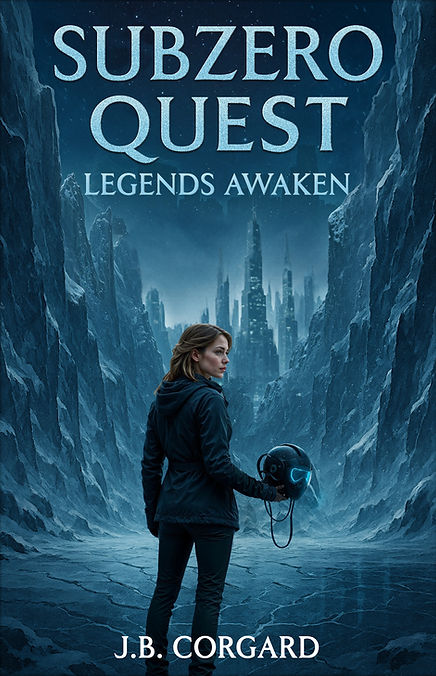
Subzero Quest
The world is buried in ice, but for Hannah Anderson, survival means more than braving frozen Chicago—it means finding a way to save her family. When she learns of the Virtual Deck, a groundbreaking tournament where ten thousand players will compete for a prize beyond imagining—life in the sun-lit Equatorial Zone—Hannah seizes her only chance. But the deeper she’s drawn into the brutal contest, the higher the cost becomes. Subzero Quest: Book One blends desperate scavenging, fierce competition, and the fragile hope of escape into a relentless sci-fi adventure where every choice could tip the balance between survival and ruin.
while my book is available on major retailers like Amazon and Barnes & Noble, i strongly encourage readers to support local, independent bookstores. you can walk into your nearest bookstore and get it.
CHICAGO METRO REGION
Once one of North America’s largest population centers, Chicago became one of the hardest-hit cities during the Great Freeze. Decades of falling temperatures, crop failures, and mass migration pushed millions south toward the warmer regions that would eventually become the New USA.
Today, only a fraction of the city’s former population remains.
Towering skyscrapers still rise above the frozen landscape, many abandoned and entombed in ice. Vast sections of the city stand silent, preserved by the cold like monuments to a lost age. Yet Chicago is far from dead.
The city survives as a northern industrial hub, built on salvage, manufacturing, and resource recovery. Freight trains carry supplies between isolated settlements while crews venture into the frozen ruins searching for anything that can be reclaimed and reused.
Life here is harsh. Winters average nearly -30°F, and survival often depends on preparation, community, and determination.
For people like Hannah Anderson, Chicago is home.
But it is also a constant reminder of how much the world has changed.
The New USA
Born from decades of migration, the New USA became the largest population center in North America after much of the northern continent became too cold to sustain normal life.
Stretching across the warmer southern states — including Georgia, Alabama, Mississippi, Louisiana, and eastern Texas — the region grew into a dense, crowded urban corridor where millions of people live packed into towering apartment blocks, aging infrastructure, and endless city streets.
For many, the New USA represents survival. It is warmer, more populated, and more stable than the Frozen North, but life there is far from easy. Housing is scarce, jobs are fiercely competitive, and corporate influence touches nearly every part of daily life.
Hannah sees the New USA as both terrifying and mesmerizing — a place filled with noise, crowds, haze, and skyscrapers so tall they seem to swallow the sky.
It is not the dream.
But it is closer to one.
The Wall
The Wall marks the border between the New USA and the Equatorial Zone.
Constructed during the decades following the Great Freeze, it serves as the primary checkpoint between the largest surviving population center in the former United States and its most prosperous region. Stretching across the Florida border region, the Wall regulates the movement of people, goods, and information between two vastly different worlds.
To the north lies the New USA, home to more than fifty million people spread across the warmer southern states. Towering cities, aging infrastructure, and crowded neighborhoods define much of daily life. While the New USA remains stable, resources are limited, opportunities are fiercely competitive, and millions struggle to build a better future for themselves and their families.
Beyond the Wall lies the Equatorial Zone.
Warm. Wealthy. Exclusive.
Home to powerful corporations, advanced research facilities, and some of the highest standards of living in the former United States, the Equatorial Zone represents a life that many people can only dream about. Its cities are cleaner, safer, and more technologically advanced than those found anywhere else in the country.
The Equatorial Zone is not the only habitable region left on Earth. Other nations developed their own solutions to survive the changing climate, and prosperous regions exist across the globe. For citizens of the former United States, however, the Equatorial Zone is the closest example of what life could be. It is the place seen in advertisements, news broadcasts, and corporate promotions. The place where success stories begin.
Access is tightly controlled.
Most citizens of the New USA will never cross the Wall. Travel permits are difficult to obtain, and permanent residency within the Equatorial Zone is granted only to a select few. For many, the border is less a physical barrier and more a symbol of the divide between the life they have and the life they wish they could reach.
For Hannah, the Wall has always been something distant. A place she heard about on the news, saw in documentaries, and read about online. It marked the edge of a world she never expected to see for herself.
That changes the moment her tournament invitation arrives.
For the first time in her life, Hannah is given something few people ever receive:
A chance to cross the Wall and step into the Equatorial Zone.
NeuroDyne
NeuroDyne is the largest technology corporation in the former United States and one of the most influential organizations of the modern era.
Founded in the decades following the Great Freeze, the company played a major role in rebuilding technological infrastructure across the country. Through advances in computing, communications, artificial intelligence, and neural interface technology, NeuroDyne helped shape many of the systems that people rely on every day.
Its greatest achievement is the development of neural-link technology, allowing users to interact directly with digital environments through specialized hardware. What once existed only in science fiction became reality through decades of research and innovation.
Today, NeuroDyne’s influence extends far beyond consumer technology. The company operates research facilities, communication networks, manufacturing centers, and data infrastructure throughout the former United States. Its products and services are used by millions of people every day.
To many, NeuroDyne represents progress, innovation, and the promise of a better future. To others, its enormous influence raises questions about the growing role corporations play in society.
Regardless of opinion, NeuroDyne has become a defining force of the modern age. Few organizations have done more to shape life in the former United States than the company whose technology helped connect an entire generation.
The First Global VR Tournament
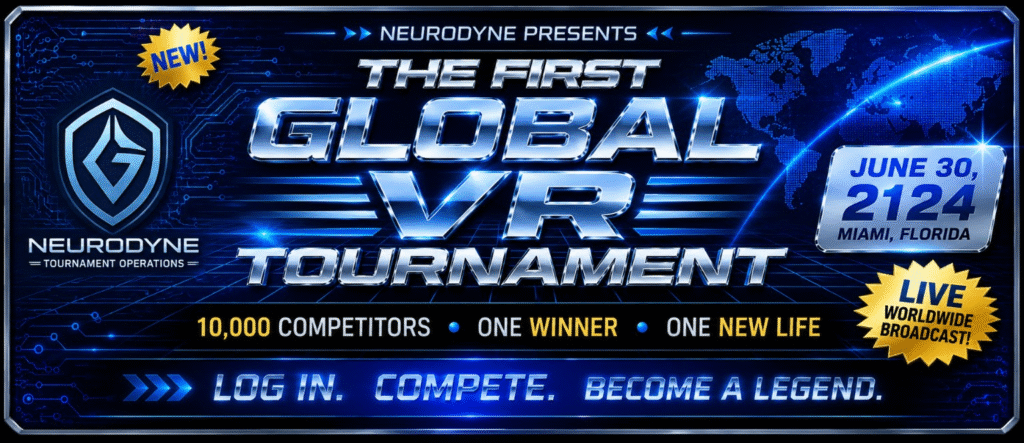
In 2124, NeuroDyne announced the largest virtual reality competition ever held in the former United States.
The First Global VR Tournament brings together ten thousand competitors from across the country, each selected from a pool of more than 8.7 million applicants. Participants are transported to a newly developed virtual world where they will compete for fame, fortune, and the opportunity to become part of gaming history.
For most people, the tournament is entertainment.
For the competitors, it is something far greater.
The event is broadcast worldwide, drawing billions of viewers eager to follow the challenges, rivalries, and victories that unfold inside the simulation. Every action is recorded. Every decision matters. Every competitor knows that a single moment could change their life forever.
To many citizens of the New USA, the tournament represents a chance to escape the hardships of everyday life, even if only for a few hours. To those selected to compete, it represents an opportunity few people will ever receive.
For Hannah Anderson, it is the beginning of an adventure she never expected.
What starts as a dream opportunity quickly becomes something much larger than a game.